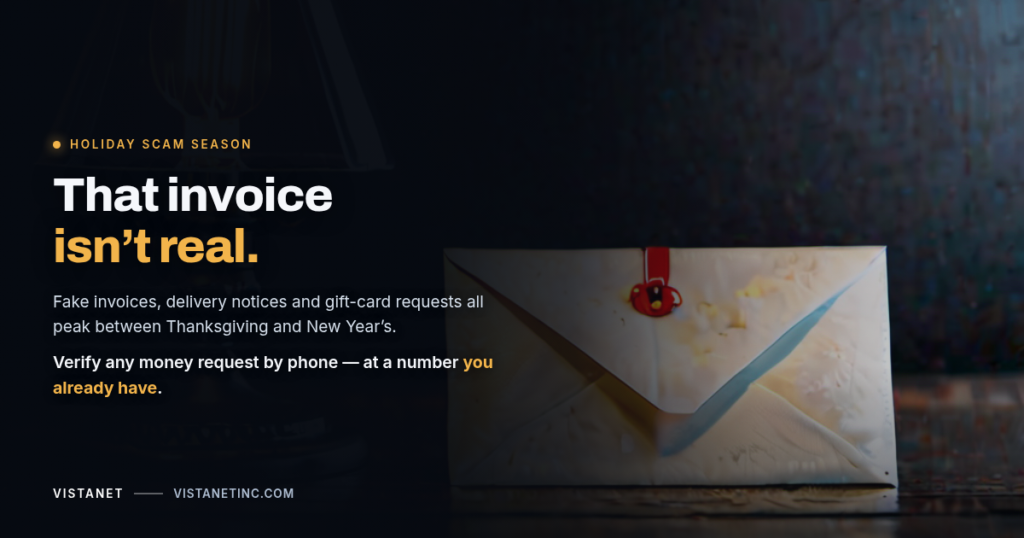
Every year between Thanksgiving and New Year’s my phone gets busier, and it’s almost never something related to holiday fun or an awesome tech gift.
The pattern is predictable. A shipping notice for a package nobody ordered. An “updated remittance details” email that looks exactly like the one your real vendor sends. A text from the boss asking for gift cards before a client meeting. An invoice that’s genuine in every way except the bank account number.
The numbers track what my clients see. IC3 logged 191,561 phishing and spoofing complaints in 2025, the most-reported crime type, and business email compromise cost $3.05 billion on its own. APWG counted 1.07 million phishing attacks in Q2 2026, with wire-transfer BEC attempts up 88%. Treasury’s holiday advisory this month leads with the same four: phishing, fake storefronts, gift card fraud, charity scams.
Four rules for the next five weeks:
- Any request involving money, payroll, or a changed bank account gets verified by phone at a number you already have. Not the number in the email.
- Urgency is the tell. Real accounting departments don’t need an answer in ten minutes.
- Delivery notices go to the carrier’s site directly. Never the link, never the QR code.
- If someone clicked or paid, call your IT department and the bank in the same hour. There’s a window where transfers get reversed, and it closes fast.
Report the weird ones. I’d rather look at fifty legitimate emails than clean up one wire transfer. Nobody gets in trouble for flagging a fake.
Sources
- FBI IC3, 2025 Internet Crime Report — 191,561 phishing/spoofing complaints (most-reported crime type); BEC 24,768 complaints / $3,046,598,558 losses; AI-related descriptor 22,364 complaints / $893,346,472; total losses $20.877B, +26% YoY.

Click to access 2025_IC3Report.pdf


- APWG, Phishing Activity Trends Report Q2 2026 — 1,069,681 attacks (+10.1%); 425,808 in June, highest month since April 2023; wire-transfer BEC attacks +88%, average attempted theft $61,732 (+45%); smishing +40%.

Click to access apwg_trends_report_q2_2026.pdf


- U.S. Treasury OCCIP, "Staying Cyber-Safe This Holiday Season" (released Nov 18, 2026) — top holiday scams: phishing/spoofing, online sales fraud, gift card fraud, charity scams; AI-enabled impersonation guidance.
https://home.treasury.gov/news/press-releases/sb0694/

- Visa, 2026 Holiday Fraud Trends — five scams: fake stores, package delivery, charity, gift cards, AI voice cloning.

Click to access holiday-threats-report-2026.pdf


- CISA / NICCS, "Shop Smart, Stay Secure: Cybersecurity Tips for the Holidays" (Nov 20, 2026) — click-avoidance, MFA, credit-card-over-debit, verify-before-you-buy.
https://niccs.cisa.gov/news-events/featured-stories/shop-smart-stay-secure-cybersecurity-tips-holidays
Recent Posts
-
 Holiday scam season opens now
-
 Critical NGINX ‘NGINX2Root’ bugs let attackers hijack servers
-
 FBI warns ARTEX AI hacking tool is powering global cyberattacks
-
 VU#604762: Multiple vendors vulnerable to Unicode Normalization Collision on macOS (APFS)
-
VU#644655: TightVNC and UltraVNC Viewer contains a heap-based buffer overflow